
From Real-World Consumption to the Digital Economy: How Will Future Business Models Evolve?
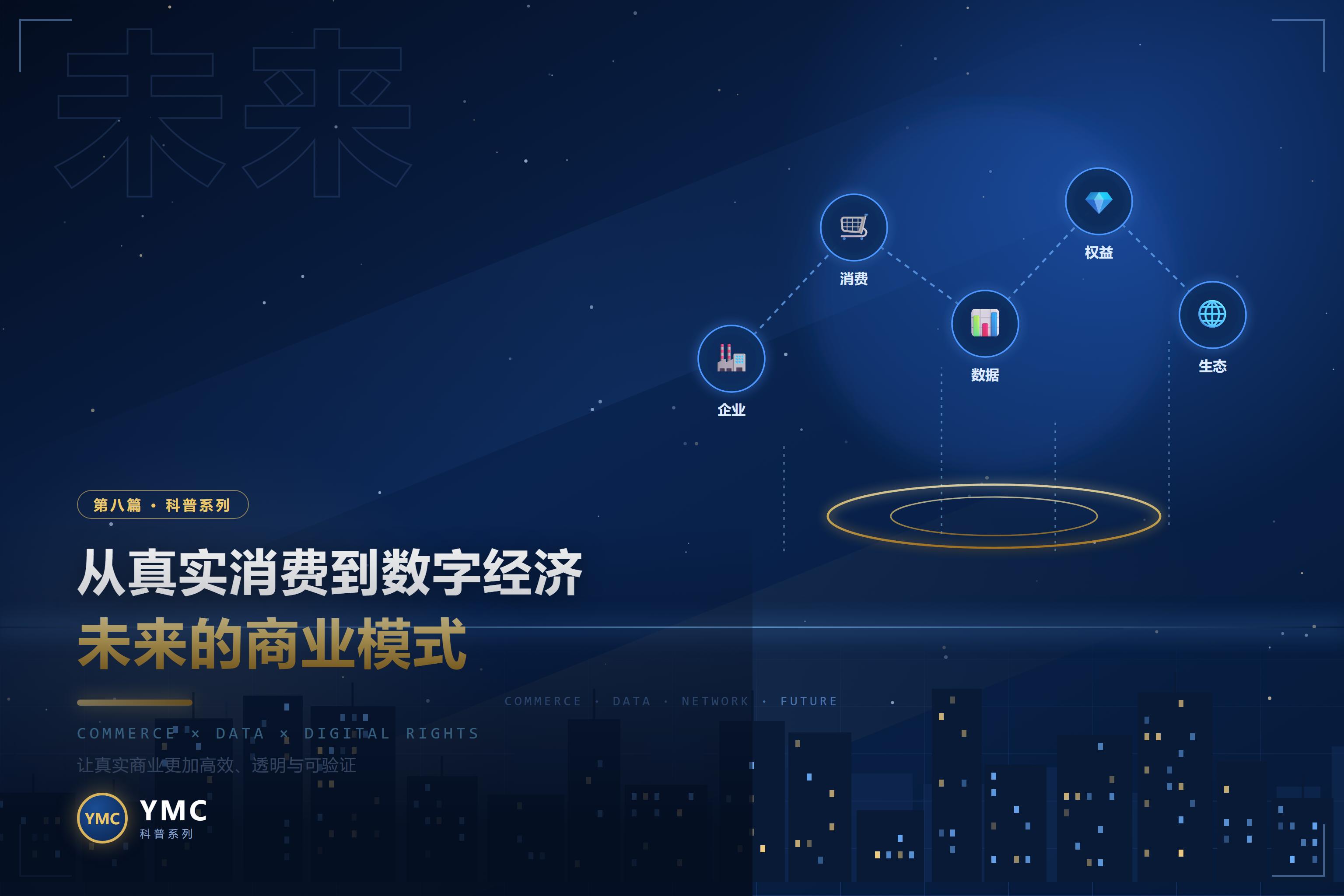
What new possibilities emerge for commerce when products, consumers, and digital systems are interconnected?
Traditionally, commerce has centered on the exchange of goods for payment—a process primarily focused on product delivery and financial settlement.
With the advancement of digital technologies, however, business activities are undergoing a transformation.
Orders can be recorded, services managed digitally, entitlements distributed via automated systems, and transaction data verified—provided the necessary conditions are met.
This prompts a question:
Will the future of commerce evolve beyond simple product transactions toward a model where goods, services, data, and digital entitlements are all interconnected?
01 Digitalization in commerce: More than just moving processes online
Many enterprises already utilize online storefronts, membership systems, order management tools, and customer service platforms.
While these tools certainly enhance operational efficiency, a deeper level of digitalization considers how these disparate systems can work in synergy.
For instance:
- How can product information be linked to specific order records?
- How can consumer membership entitlements be managed with precision?
- How can order status be synchronized with service workflows?
- How can redundant data entry across different business systems be minimized?
- How can data utility be maximized while ensuring privacy and regulatory compliance?
In short, digitalization is not merely about shifting traditional operations onto computers or mobile devices; it is about enabling business data to flow in a more standardized and structured manner.
02 From product transactions to digital entitlements
Consider a typical consumer scenario:
A customer purchases a product; the business provides after-sales support according to established policies, while simultaneously recording the customer’s entitlements within a membership system.
If these entitlements are governed by clear, defined rules, users can leverage them for future services, redemptions, or other eligible use cases.
Such models can already be implemented using conventional databases and membership management systems.
Blockchain, meanwhile, offers an alternative technical foundation—one that can be particularly well-suited for managing digital credentials, transaction records, or the transfer of entitlements.
It is important to note, however, that:
Not all digital entitlements require blockchain technology, nor do all blockchain-based entitlements necessarily fall under the category of "Real-World Assets" (RWA).
The choice of technology should always be driven by the specific needs of the business.

03 Potential Development Directions for the Digital Economy

The level of development varies across these areas; some are already in widespread use, while others require further exploration.
04 From what perspectives can the YMC ecosystem be examined?
By considering YMC’s existing real-world products, consumer-facing operations, and digital ecosystem mechanisms, one can understand its development trajectory from several different angles.

Through these perspectives, one can gain a more comprehensive understanding of a digital ecosystem, rather than focusing solely on an individual asset or a specific activity.
05 What is truly worth anticipating in the future of business?
The evolution of business does not necessarily imply that all real-world assets will be tokenized.
What warrants greater attention is whether digital technologies can help enterprises solve practical problems:
- Enhancing the accuracy of business data.
- Clarifying the rules governing rights and entitlements.
- Making transaction records easier to verify.
- Creating more effective connections between goods, services, and user needs.
- Reducing the costs of information coordination in relevant scenarios.
These changes may stem from blockchain, artificial intelligence, the Internet of Things (IoT), traditional databases, or a combination of various technologies.
Technology is merely a tool; what truly matters is whether it addresses actual needs.
Conclusion:
From tangible goods to digital entitlements, and from business data to ecosystem applications, there is vast room for exploration between the real economy and the digital economy.
While Real-World Assets (RWA) represent a noteworthy direction, they are not the sole solution for the digitalization of business.
For YMC, understanding the interplay between real-world consumption, digital entitlements, ecosystem applications, and transparent mechanisms provides a clearer lens through which to identify future development opportunities.
The future of the digital economy lies not just in how assets are digitized, but in whether technology can render real-world business more efficient, transparent, and verifiable.