
Why Is Compliance Indispensable for RWAs? Digitization Is Not Equivalent to Asset Titling
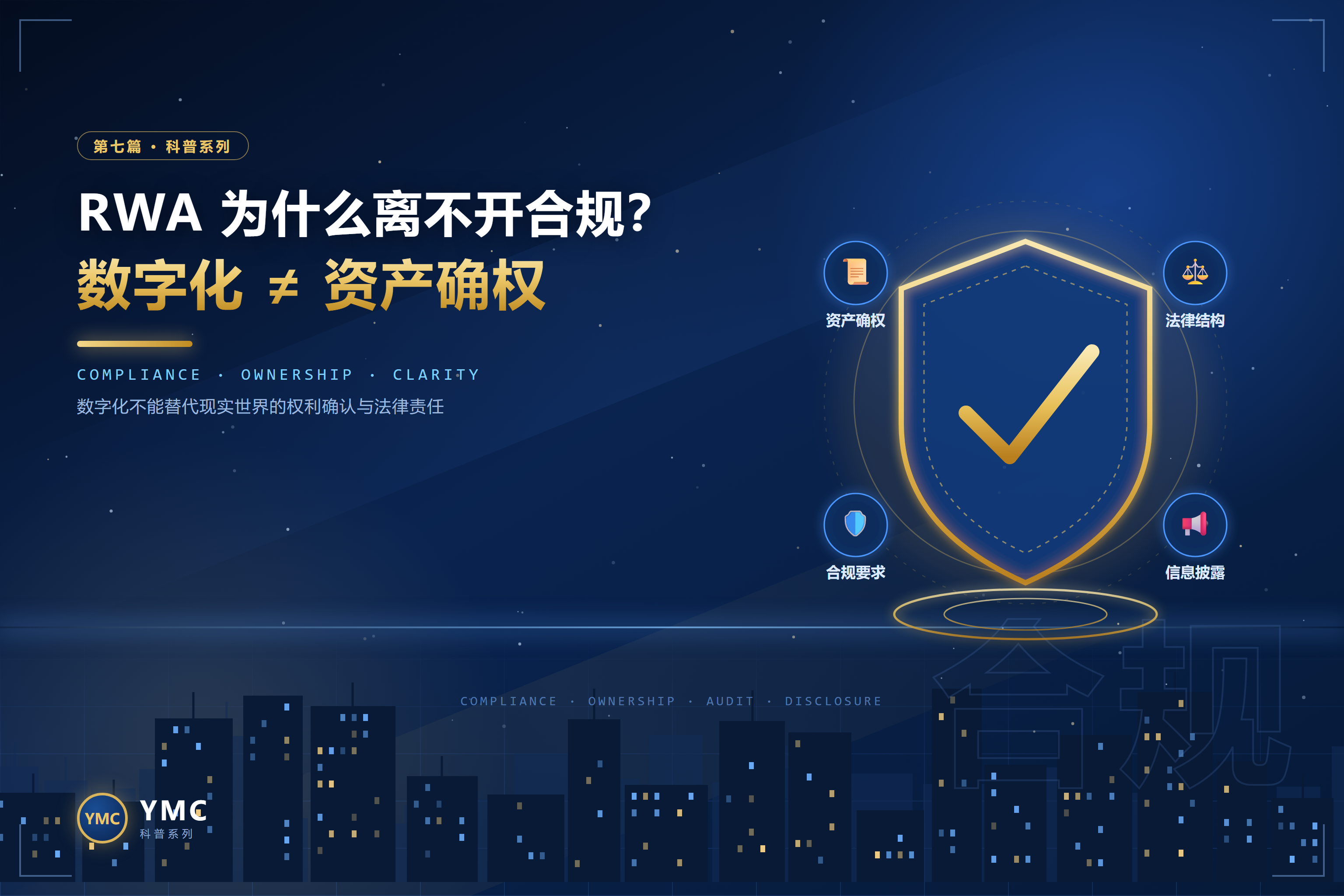
Once a real-world asset is digitized, are the associated rights truly clear?
Consider a company that owns a real-world asset.
The company enters information about this asset into a system and uses blockchain technology to generate a digital token or certificate.
From a technical standpoint, this process may well constitute a form of digitization.
However, a critical question arises:
Does holding this digital token or certificate automatically equate to owning the underlying real-world asset?
The answer is: not necessarily.
This is a crucial distinction that must be carefully understood when dealing with Real-World Assets (RWAs).
01 Digital Tokens and Real-World Rights Are Not the Same Thing
An asset can be understood across two distinct dimensions:
The Digital Dimension
Tokens, digital certificates, on-chain transaction records, smart contracts, etc.
The Dimension of Real-World Rights
Asset ownership, contractual rights, rights to income, claims (creditor rights), usage rights, and their associated legal limitations.
While the two can be linked through appropriate legal arrangements and operational design, this connection is not automatically established simply by the existence of a digital token or certificate.

For example:
The fact that a piece of real estate is recorded on a blockchain does not automatically mean that the holder of the corresponding token is the legal owner of that property in the official real estate registry.
If a digital token represents a debt claim, it is necessary to clearly define the creditor, the debtor, the contractual terms, and the relevant legal arrangements.
Therefore, determining whether a Real-World Asset (RWA) has a solid legal foundation in the real world requires an understanding of the specific legal relationships underlying it.
02 What must be considered for a relatively comprehensive RWA project?
An RWA initiative is not merely a technical development project.
It typically involves a range of real-world considerations.
Key Aspects | Issues to Address
Asset Verification | Does the asset actually exist? Who holds the rights to it?
Legal Structure | What specific rights does the token represent? Are the contractual terms clear?
Asset Management | Who is responsible for the custody, operation, or management of the underlying asset?
Valuation & Auditing | How is the asset’s value assessed? How is the relevant information verified?
Technical Security | How are risks managed regarding smart contracts, wallets, and the overall system?
Compliance Requirements | Does the project involve securities, payments, financial promotion, or other regulated activities?
Information Disclosure | Can users clearly understand the associated rights, risks, and limitations?
Different types of assets may be subject to entirely different legal requirements.
Consequently, it is not possible to apply a single, simple set of standards to all RWA projects.

03 Why is real-world business the foundation, yet not the whole picture?
Real-world goods, transactions, and business activities provide the tangible context for digital applications.
However, the mere existence of a real-world business does not mean that all associated digital assets are automatically backed by real-world assets (RWAs).
For instance, a company might sell physical goods and design a digital ecosystem around these sales.
While this demonstrates a foundation in real-world business activity, claiming that a specific digital asset represents ownership of those goods, a right to fixed income, or other specific legal entitlements requires formal legal arrangements and supporting evidence.
Real-world consumption, digital entitlements, and RWA assets in the legal sense must be understood as distinct concepts.
This does not negate the value of connecting real-world business with the digital economy; rather, it ensures that such connections are clear and reliable.
04 What foundational work should be prioritized when exploring the RWA space?
For ecosystems aiming to bridge real-world business with the digital economy, key areas of focus include:
- Recording information regarding real-world goods and business processes.
- Establishing statistical standards and verification methods for business data.
- Clearly defining digital assets and digital entitlements.
- Transparently disclosing business rules and user rights.
- Mapping the relationship between on-chain records and off-chain business activities.
- Identifying applicable laws, regulations, and compliance requirements across different jurisdictions.
These efforts help clarify the relationship between real-world business activities and digital systems.
Ultimately, whether a specific project constitutes an RWA in the legal sense depends on its asset structure, contractual arrangements, actual entitlements, and the governing legal framework.
05 How should the average user evaluate such projects?
When encountering any project that claims to be related to RWAs, consider asking these five questions:
1. What exactly is the underlying asset or real-world business?
2. What specific rights does the digital token or certificate I hold represent?
3. What contracts or legal arrangements support these rights?
4. Which information can be independently verified, and which relies solely on disclosures from the project team?
5. What mechanism is in place to resolve disputes should they arise?
These questions are relevant not only to RWAs but also to other types of digital assets and digital entitlement projects.

Conclusion
RWA (Real-World Assets) warrants attention because it seeks to bridge the real world and the digital realm.
However, a truly reliable connection cannot rely solely on technical concepts or promotional narratives.
It requires a foundation in genuine business operations, clearly defined rights, trustworthy data, and appropriate compliance frameworks.
While digitalization can transform how asset-related information is represented and circulated, it cannot serve as a substitute for the formal validation of rights or the legal liabilities that exist in the real world.