
Why are transparent records on the blockchain important?
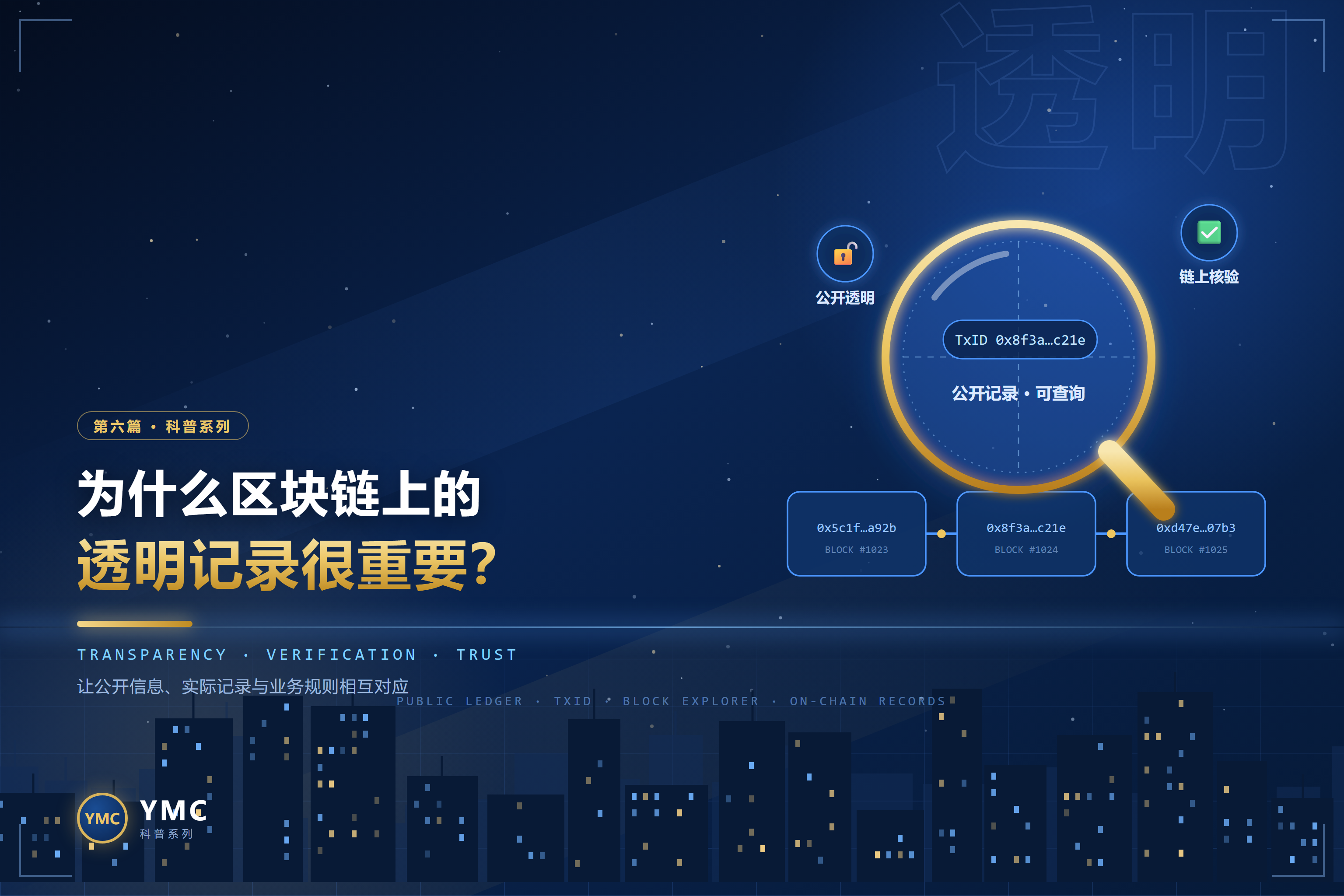
Why can’t the development of the digital economy rely solely on storytelling?
As the digital economy continues to evolve, users are exposed to an ever-increasing volume of information.
We frequently encounter various business announcements, transaction data, descriptions of digital assets, and strategic roadmaps for ecosystem development.
Yet, when faced with such information, a more critical question arises:
Can we verify these records through a reliable method?
One of the primary reasons blockchain has garnered so much attention is its ability to provide a public, verifiable record-keeping mechanism for specific digital transactions.
01 What are on-chain records?
Blockchain can be understood as a digital ledger, collectively maintained by network participants according to a set of predefined rules.
Once a valid transaction is recorded on the blockchain, the associated information can typically be accessed via a blockchain explorer.
Common types of information that can be queried include:

The specific information that can be retrieved depends on the blockchain being used, the design of the smart contract, and the level of transparency.
These records allow users to verify whether a particular on-chain operation has taken place.
02 What is a transaction hash?
A transaction hash—often referred to as a "TxID"—serves as a unique identifier for an on-chain transaction.
By entering a transaction hash into a blockchain explorer that supports such queries, users can view the records associated with that specific transaction.
For instance, when verifying a public transaction—such as the purchase or burning of a digital asset—one might focus on checking the following:

03 On-chain transparency does not mean that all information is transparent.
This is a point that is easily overlooked.
While blockchain can record specific on-chain operations, much of the information from the real world is not automatically captured on-chain.
For example:
- Whether a product was actually manufactured.
- Whether an order was truly delivered.
- Whether a relevant contract is legally binding.
- The identity of the actual controller of a specific address.
- Whether an on-chain asset corresponds to a genuine real-world asset or right.
These matters still require support from business systems, contractual documentation, audit materials, third-party verification, or other appropriate forms of evidence.
Therefore, when evaluating the transparency of a digital ecosystem, one cannot simply look at whether a few transaction hashes have been made public.
It is also necessary to determine whether there is a clear and reliable correspondence between the on-chain records and the off-chain business operations.
04 How should YMC’s "buyback and burn" disclosures be interpreted?
In the context of YMC-related operations, the public disclosure of buyback and burn records serves as a channel for users to understand how these activities are being executed.
When reviewing such disclosures, you may want to focus on the following aspects:
Buyback Disclosures
Pay close attention to the reporting period, the definitions used for buyback quantities or amounts, the execution dates, and the corresponding transaction records.
When verifying, be careful not to conflate different metrics—such as quantities, monetary values, and the specific criteria used for statistical reporting.
Burn Disclosures
Focus on the quantity burned, the execution timestamp, the transaction hash, and whether the on-chain records align with the information provided in the announcement.
During verification, confirm the actual execution status of the transactions, rather than relying solely on the text provided in the announcement.

It should be noted that the specific business implications of any public disclosure should be interpreted based on officially defined terms and actual transaction records.
Furthermore, the mere existence of buyback or burn records does not imply that the price of a given digital asset will necessarily rise, nor does it guarantee any future returns.
05 Why do transparent mechanisms help build trust?
The value of a transparent mechanism lies in enabling users to move beyond relying solely on one-sided written statements; instead, they can independently verify information based on relevant data.
When statistical criteria are clearly defined, records are accessible, and execution outcomes can be cross-checked, it becomes much easier for users to understand the actual nature of a business operation.
However, transparency is not a one-time task.
It requires continuous, accurate, and consistent information disclosure, as well as the prompt correction of erroneous data and clear explanations of the underlying business rules.
Conclusion
While blockchain cannot automatically resolve every issue related to trust, it does provide a technical means for the public verification of specific digital transactions.
True, meaningful transparency goes beyond simply publishing a hash; it requires that public information, actual transaction records, and business rules all align with one another.
This serves as a key benchmark to keep in mind when evaluating the digital economy and applications related to Real-World Assets (RWA).