
From MAIONE to YMX: How Does Real-World Consumption Connect to the Digital Economy?
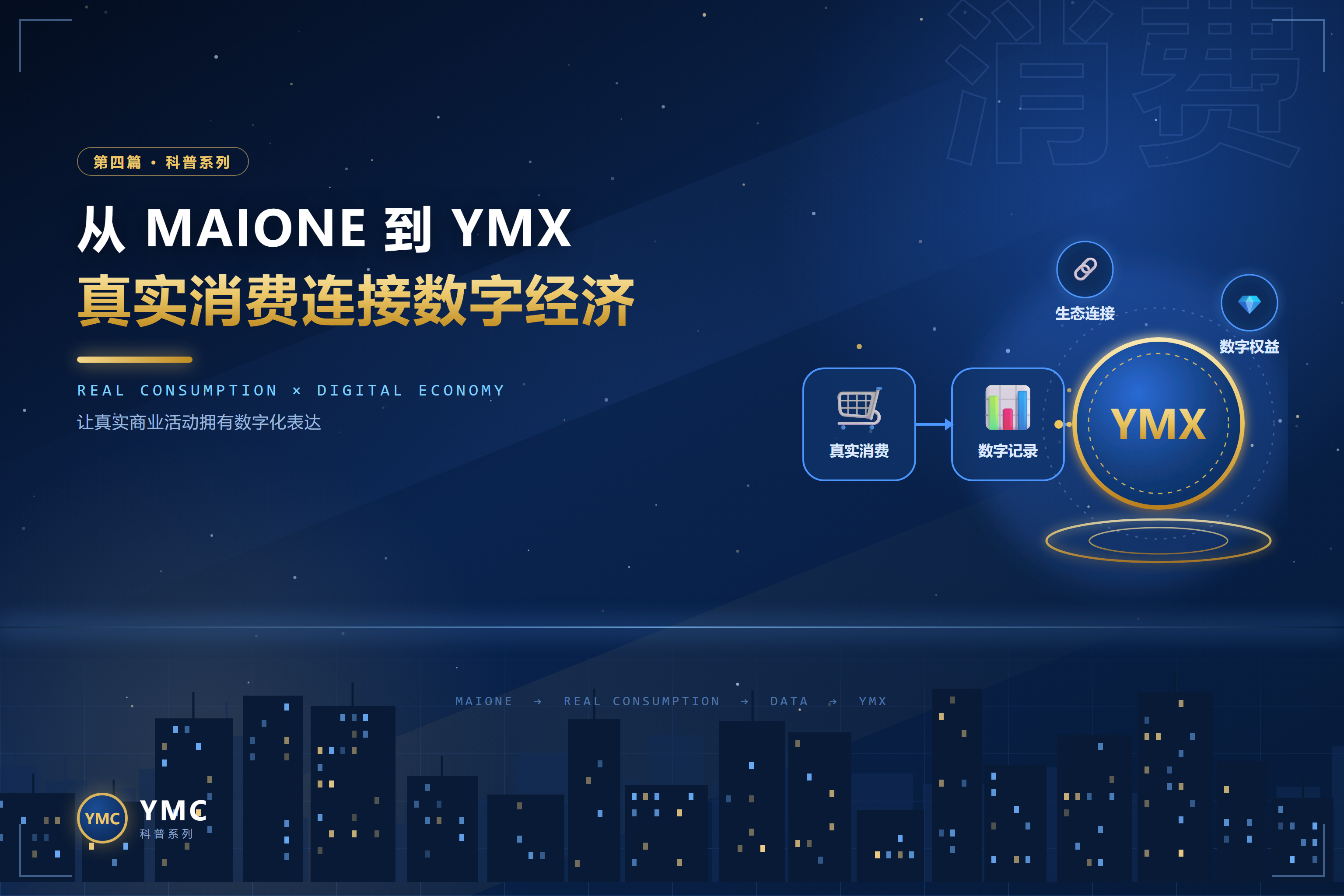
What happens when a tangible product enters the realm of the digital economy?
We engage in consumption every single day.
Purchasing a skincare product, utilizing a service, or completing a transaction—these seemingly mundane actions are, in fact, vital components of how the real-world economy functions.
But have you ever stopped to consider:
What kind of connection can truly be forged between real-world consumption and the digital economy?
This is precisely why RWA (Real-World Assets) and the digitization of the real-world economy are areas worthy of attention.
01 Starting with a Tangible Product
The operational logic of traditional commerce is straightforward.
Businesses manufacture products, consumers purchase them, companies generate sales revenue, and various links within the supply chain carry out their respective operational activities.
Throughout this process, products, capital, orders, and transaction records collectively form a tangible commercial chain.

Take "MAIONE Youth-Locking Series" (MAIONE青春定格) as an example: it is, first and foremost, a tangible product with specific commercial attributes and defined consumption scenarios.
When a consumer purchases the product, a genuine commercial transaction takes place.
If such commercial activities can be managed through standardized data recording and digital systems, it creates a clearer business foundation for applications within the digital economy.
Therefore, what warrants attention is not merely the product itself, but the authentic commercial activity that lies behind it.
02 How does real-world consumption connect to a digital ecosystem?
This process can be understood as consisting of several layers:
Layer 1: Tangible Products
Products exist in the physical world and possess concrete commercial attributes.
Layer 2: Real-World Consumption
Consumers purchase products, giving rise to genuine commercial transactions.
Layer 3: Digital Recording
Orders, transactions, and related business information are captured via digital business systems.
Layer 4: Ecosystem Applications
In compliance with established rules, digital rights and entitlements are integrated into various application scenarios, such as payments or redemptions.

These four levels do not imply that a single transaction automatically generates RWA (Real-World Asset) tokens.
Rather, they outline a developmental approach: providing a more standardized digital representation for real-world commercial activities, and integrating these into a digital ecosystem governed by appropriate business rules.
03 What role does YMX play in this?
Within the existing YMC ecosystem, there is a specific operational mechanism linking YMX to the sale of actual products.
According to the current framework, the sale of every bottle of "Youth-Locking" (青春定格) product triggers a $10 purchase of YMX.

This provides a concrete case study for understanding the connection between real-world sales and digital ecosystems.
However, it must be clarified that the associated purchasing mechanism is not equivalent to the consumer holding direct legal ownership of the underlying goods; nor does this mechanism alone suffice to classify YMX as an RWA (Real-World Asset) in the legal sense.
To understand a digital ecosystem, one must examine how it connects to real-world commerce, how specific rules are enforced, how data is verified, and how relevant rights are defined.
04 What truly warrants attention in the future?
As real-world consumption becomes increasingly linked to digital systems, future areas for exploration include:
- How can the accuracy and traceability of commercial data be improved?
- How can business rules be made clearer and more transparent?
- How can digital rights be logically connected to real-world goods or service scenarios?
- How can compliant digital infrastructure enhance operational synergy and efficiency?
These questions hold far more practical significance than merely debating the name of a specific digital asset.
Conclusion:
From physical goods and real-world consumption to digital records and ecosystem applications, there exists a space for ongoing exploration—a bridge between the real economy and the digital economy.
While the operational mechanisms of YMX serve as a useful case study for observing this trend, the development of truly mature RWA applications requires the establishment of clear frameworks for asset ownership, legal relationships, data verification, and regulatory compliance.
The value of the digital economy lies not only in what can be created within the digital realm, but also in its capacity to forge reliable connections with the real world.