
What exactly is RWA?
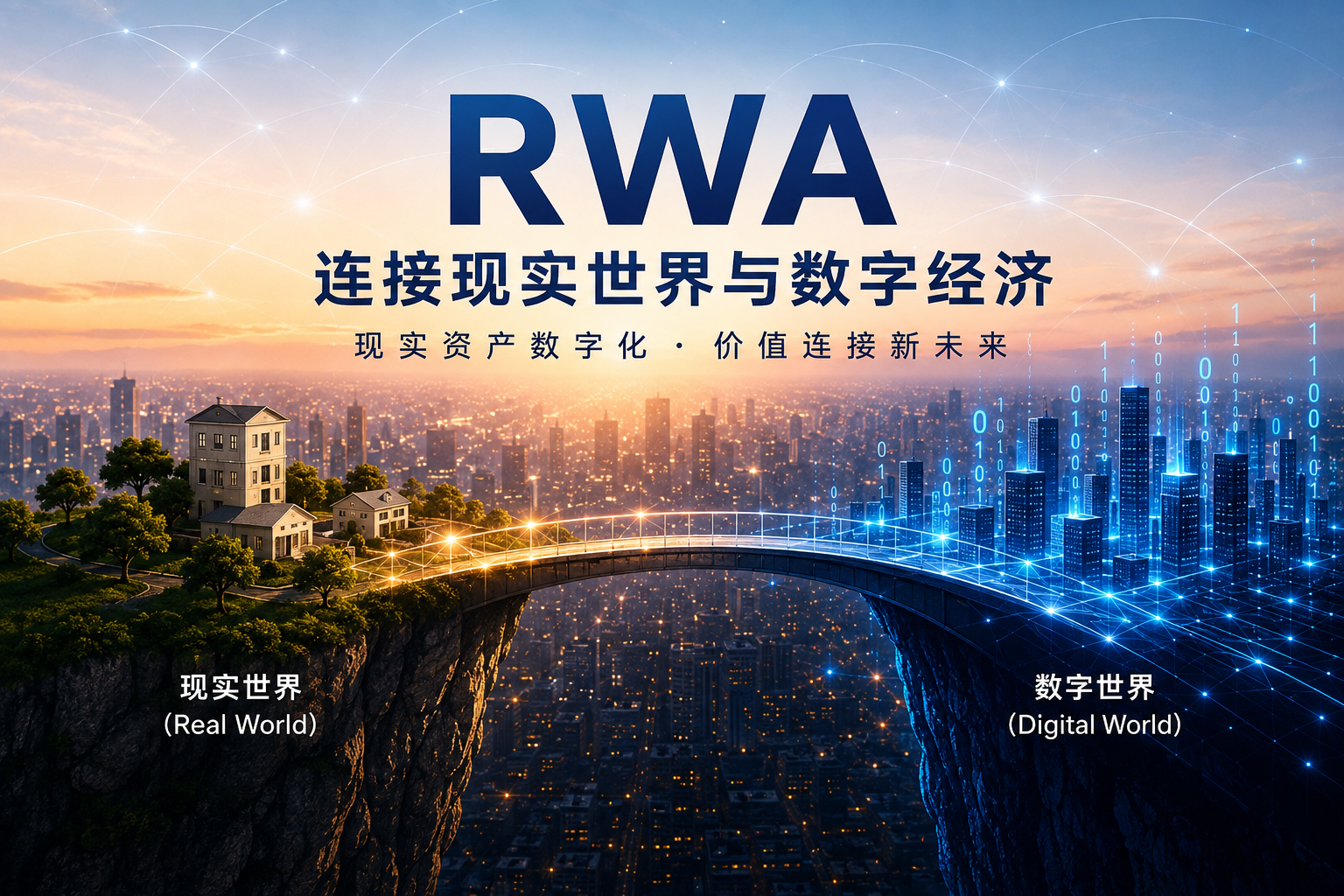
When real-world assets start entering the digital world
In the past few years, we've often heard a term: RWA.
Some say it’s an important direction for the next wave of blockchain development;
Some believe it will change traditional finance;
And some simply understand RWA as:
"Putting real-world assets onto the blockchain."
But if you only understand it this way, it’s actually not enough.
So, what exactly is RWA?
---
01 What is RWA?
RWA stands for:
Real World Assets
In Chinese, it’s usually translated as:
现实世界资产 (real-world assets)
Simply put, it’s about connecting assets, rights, or economic value that already exist in the real world to blockchain and digital economic infrastructure through digitalization, tokenization, and other means.
For example:

In the past, most of these assets existed within traditional finance and the real economy.
The problem blockchain aims to solve is:
Can we bring the value of the real world into the digital economy in a more digital, transparent, verifiable, and programmable way?
This is an important reason why RWA has attracted attention.
---
02 Why did RWA suddenly become popular?
Actually, 'asset digitization' isn’t something new.
Electronic securities, digital bank accounts, electronic contracts, and so on are all essentially part of the digitization process.
But blockchain brings a new possibility:
It allows assets, ownership, trading rules, and transaction records to enter a digital environment that can be executed by programs.
Traditional asset trading might require:

Under more mature blockchain infrastructure, some transaction processes can theoretically be programmed.
This means:
Assets can be digitized.
Rules can be programmed.
Transactions can be automated.
Records can be publicly verified.
This is also why global financial institutions are starting to take asset tokenization seriously.
The BIS (Bank for International Settlements) believes that tokenization can combine asset information, ownership, and transaction rules into a programmable ledger, thereby changing the way parts of the financial market operate.
---
03 The most important thing about RWA isn’t the 'Token'
This is the most important point to understand about RWA.
Many people, when they see RWA, immediately think:
"Just issue a token."
But in reality:
The token is just a tool.
The truly important question is:
What’s behind the token?
For example:
A digital certificate represents a real set of asset rights;
A digital certificate represents a real business contract;
A digital certificate represents a real entitlement to goods or services.
This is completely different from simply creating a number.
Therefore, a mature RWA system at least needs to consider:
Where does the value come from?
What exactly are the rights?
Who owns these rights?
How to prove it?
How to trade?
How to regulate?
If disputes arise, what are the real-world legal relationships?
So:
RWA is not just about "packaging real assets into tokens."
It’s actually trying to build a bridge between the real economy and the digital economy.
---
Why is RWA different from ordinary digital assets?
We can make a simple comparison.

Of course, this doesn't mean that RWAs are necessarily 'more valuable' than other digital assets.
It's just that:
They solve different problems.
---
05 What RWAs truly change is the 'way value is connected.'
In the past:
There was a fairly clear boundary between
real-world assets
and
digital assets.
What RWAs try to do is:

Thus, a new economic cycle began to emerge.
This is also why many people believe:
RWA may become an important infrastructure connecting the real economy with the digital economy.
---
06 So, can consumption also become part of the RWA ecosystem?
This is a question worth considering.
In the past, when we understood "assets," we usually first thought:
Houses, land, gold, stocks.
But where the real economy truly takes place with massive daily activity, there is another very important area:
Consumption.
Every day, there are:
Product sales.
Service consumption.
Supply chain flow.
Business operations.
User trading.
These activities themselves form an important part of the real economy.
Therefore, the future development of the digital economy may not be just:
"Move real estate, gold, and bonds onto the chain."
Further exploration may be possible:
How to connect the data, rights, and value generated by real business activities more effectively to the digital economy.
This is where a very interesting direction emerges:
Real Economy×Digital Economy
---
07 This is also a question YMC has been pondering
Yijia International YMC ecosystem is currently gradually establishing a structure consisting of:
Real products
Real consumption
Digital Rights
Digital assets
Ecosystem applications
forming a digital ecosystem.
Take MAIONE's youth freeze as an example.
It is, first and foremost, a real product.
Consumers buy products.
Businesses generate real sales.
Real consumption generates real business activity.
In the future, if these real business activities can connect with the ecosystem in a more transparent, standardized, and digital way, it can form:

This is also an important reason why YMC focuses on RWA and the development of the digital economy.
---
08 The Future of RWA: Beyond Finance
When many people hear RWA, they immediately think of:
Tokenized real estate.
In fact, the scope RWA might cover in the future is very broad.
Finance is just one direction.
In the future, we might see:
Commodity RWA
Real commodities combined with digital rights.
Commercial RWA
Real business contracts integrated with digital rights.
Supply Chain RWA
Digitizing real assets and transaction data in the supply chain.
Consumer RWA
Exploring the connection between real consumer behavior and digital rights.
Carbon Asset RWA
Digitization of real-world carbon assets.
Intellectual Property RWA
Digitization of rights like copyrights and patents.
So the real point of interest in RWA isn’t:
"What’s the next token?"
It’s:
"How much value in the real world hasn’t been digitized yet?"
---
09 Why YMC is Worth Following This Trend Early
Because YMC itself already has a very important foundation:
Real consumption scenarios.
Real products.
Real users.
Real sales.
Real services.
Real business activities.
And what the digital economy needs most is exactly this:
Connecting real-world value with the digital world.
In the future, the direction YMC hopes to explore isn’t just about holding a digital asset.
It’s about gradually building:

Connections in between.
This might be where the digital economy really becomes meaningful.
---
The Real Future of RWA
In the future, we might no longer simply distinguish between:
The real economy
and
the digital economy.
Because the two will blend more and more.
We buy a product.
We might also get digital rights at the same time.
We use a service.
We might also generate digital certificates simultaneously.
A company earns actual business revenue.
It might also produce corresponding digital data.
The real world creates value.
The digital world records value.
Blockchain verifies value.
In the end:
The real world creates value
The digital world carries value
Blockchain verifies value
This might be the real reason why RWA is truly worth paying attention to.
